Whitty Worldwide is an elite team of highly trained
creative professionals who live or die on their ability to
surprise people, cut through the crap and do the impossible.
We deliver big, bold, game changing ideas without the overhead
and complicated, time wasting process you'll find in most agencies.
Whether you need a broad reach fame building campaign,
or a targeted message people find engaging and useful -
we are ready to take your brief.
Whitty Worldwide is an elite team of highly trained
creative professionals who live or die on their ability to
surprise people, cut through the crap and do the impossible.
We deliver big, bold, game changing ideas without the overhead
and complicated, time wasting process you'll find in most agencies.
Whether you need a broad reach fame building campaign,
or a targeted message people find engaging and useful -
we are ready to take your brief.
Applied Materials
Information for Everyone
A small share of voice needs a big idea.

Tokyo. Photo: RJ Muna
Even though Applied Materials had been laboring for over 30 years at building a marquee name in the semiconductor industry, less than half of the retail investment market had heard of them. Beyond awareness, only a small portion of investors appreciated the fact that Applied makes the systems used to produce virtually every new microchip in the world. Just 3% named Applied unaided when asked which tech companies they would consider investing in.
During the worst downturn in the industry’s history, we were tasked with bringing that astonishing value into sharp relief.


The immediate, yet daunting challenge was to sell a conservative board of directors on a wildly ambitious, $30 million global broadcast advertising program in year one alone—a plan that was met with immediate jeers by competitors who pointed out that Applied didn't sell a single consumer product.
We opened our pitch in the CEO’s bunker-like conference room in Santa Clara with a short film narrated by Hollywood legend Martin Sheen. I felt sure the board members would collectively cheer and bang their approval on the polished mahogany. Instead, the Chairman politely thanked us for our time and immediately moved on to the next item on the agenda. Cool as you like.
Several fingernail-biting weeks later, we were given the brief of a lifetime:
"Make Applied Materials famous for making the Information Age more accessible and affordable to everyone."
David N.K. Wang, Executive Vice President


How do you advertise a company whose systems are used to build virtually every new microchip made in the world without evoking Orwellian overtones or corporate chest-beating? Our answer was to memorably express the sheer global impact of chips and dramatize the fact that they power everything, everywhere.
SPAIN: Porsche — a company notoriously protective of its brand — had granted Applied one of the first arrangements of its kind, by allowing us to demonstrate that the limits of peak mechanical performance were being rewritten by microchips. But the 996 Turbos shipped from Stuttgart for our shoot were locked at the border due to a Foot-and-Mouth disease crisis. Worse, while we had arranged to have the mountain roads of a national park closed for several days, storms grounded our helicopter and obliterated the shooting schedule. While I stared at mounting overage bills and drank Rioja in Ronda, our producer deployed a legendary London-based fixer. The cars cleared customs. The Guardia Civil extended the Sierra de Grazalema road closure. And the clouds parted as Sammy Hagar's breakout vocal on "Space Station #5" accompanied aerial footage of Bobby Unser Jr. barreling through a mountain pass.
JAPAN: I hadn’t slept since Spain. A brief stop in London to recoup, then straight to Japan. We had arranged to shoot at the world’s busiest pedestrian crossing, the Shibuya Scramble — a living emblem of the connected world microchips had made possible, and a location so tightly controlled by the Tokyo Metropolitan Police that even Hollywood productions routinely build replica sets rather than attempt to film there directly. The location was contextually vital —Applied was doing 40 percent of its business in Japan and we couldn't afford a single slip-up. Naturally, things went sideways. The police inexplicably revoked our permit. Our tough Australian production manager gave it to me straight: the only way to reinstate it involved sitting down with the Yakuza. Fortunately, the Japanese have never been keen on discussing delicate business matters in public. The story behind our eleventh-hour reprieve remains a trade secret. The final edit was accompanied by an enigmatic track sung in Japanese by Chihiro Onitsuka, and a weekly online poll conducted by Advertising Age ultimately declared the film "the best spot in America."
CHINA: For the grand finale, we set cutting-edge silicon technology against thousands of years of human engineering. Legendary film producer Charles Wang helped us become the first advertiser in history to shoot inside Peking’s Forbidden City and along the Great Wall of China. Throughout the production, we were shadowed by somber-looking members of the CCP. Thankfully, all I suffered on this adventure was a nasty bout of dysentery.
We carried that same nothing-is-impossible brief into print and outdoor photography in Mumbai, New York, San Francisco, Tokyo, and Andalusia.


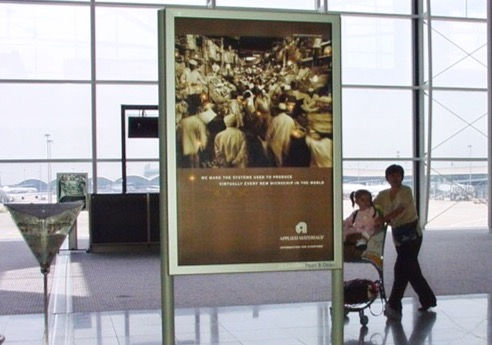


Facing a volatile market, CEO Jim Morgan leveraged the campaign to address the industry and press, elevating the brand narrative into a macroeconomic mission statement: proof that Applied Materials wasn't just selling machines; it was democratizing the digital age.
By leaving the “cake in the oven” — resisting the urge to change the messaging prematurely — the strategy allowed the narrative to bake into the market’s consciousness, creating an unforgettable and enduring cognitive shortcut. Within five years, it had reshaped how the retail investment market talked about the company.
-
Performance: Public recognition and ad interest completely outstripped the heavily funded campaigns of Intel, IBM, and Cisco.
-
Fame: NASDAQ’s national “Listed on NASDAQ” campaign named Applied, alongside Microsoft, Costco, and Starbucks, as one of the companies and stories that were “embodiments of the American dream fulfilled” — cultural proof that a name few investors could once place had become part of the story America told about its own future.
-
Market Value: The year before we began work, Applied Materials’ stock reached a 52-week low of $26.59. By making its role easier to understand, remember, and value, the “Information for Everyone” idea endured beyond the advertising. It was formally codified in Applied Materials’ SEC filings and annual reports, and later became the title of the official book celebrating the company’s 35-year history. Over time, Applied became a far more widely recognized company, and its share price rose substantially — reaching an all-time high of $723 on June 30, 2026, roughly 27 times that earlier low.
Source: Hall & Partners. Ad Age. Wall Street Journal. AMAT stock data: Nasdaq / Yahoo Finance, July 2026.
Mark Whitty joined Tom Hayes on CNBC to discuss the campaign.
A NASDAQ Visionary.

"Mark Whitty possesses a rare combination of attributes for the advertising industry: he has high standards of excellence and he is a good budget manager. He provided standout, award-winning work for me at Applied Materials on a $50 million global advertising and branding campaign."
Tom Hayes, VP Marketing
Services
Brand Strategy
Qual & Quant Research
TV, Print, Outdoor, Digital
Media Planning & Buying
Design, Video, Events
Public Relations
Government Affairs
Client
Jim Morgan, CEO
Tom Hayes, VP Marketing
Collaborators
Paul Golubovich, Producer
Neville Desouza, Copy Writer
Chris Kirk, Mind Bomb Films
Charles Wang, Salon Films
Pucho Mentasti, Palomar Pictures
Peter Ker, Peter Ker Associates
Ralf Schmerberg, Radical Media
RJ Muna, Muna Pictures
Jeanne Selvester, PHD Media
Chris Liu, Ketchum PR
Wayne Sayer, Washington D.C.
Mike Hall, Hall & Partners
See other work


